
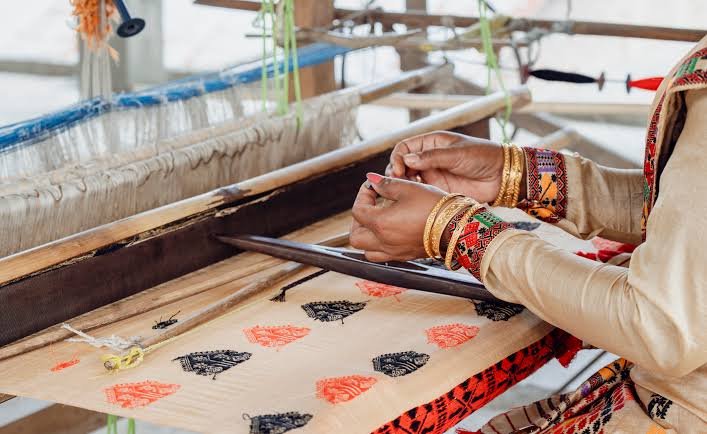
In a world governed by lightning-fast trend cycles and synthetic fibers, there is a quiet revolution unfolding at the loom.
Every second, industrial textile machines churn out miles of identical fabric. Yet, there remains an irreplaceable soul in a piece of cloth shaped by human hands, guided by a wooden shuttle, and rhythmically pressed by foot pedals.
At Torshiki, we believe that true luxury isn’t born from speed—it is sculpted by patience, culture, and artisanal memory.
The Anatomy of an Authentic Handloom
A handloom is more than wooden beams and taut warp threads; it is an instrument of storytelling.
Unlike power-loom fabrics that are mechanically uniform and flat, hand-woven textiles carry subtle organic variations. These tiny shifts in tension, grain, and dye depth are not imperfections—they are the artisan’s signature.
- Breathability & Skin Harmony: Natural fibers like wild silk, organic desi cotton, and pure linen adapt to ambient temperatures, offering effortless breathability in summer and gentle warmth in cooler air.
- Structural Durability: Hand-twisted yarns retain their natural tensile strength, meaning a well-cared-for handloom textile does not fray or pill after a few washes; it softens and grows more supple with age.
- Low-Impact Ecology: Operating entirely on human energy without electricity, handloom weaving represents one of the most eco-efficient production methods on the planet.
The Loom-to-Wardrobe Journey
Every Torshiki garment or home piece follows a meticulous, unhurried creation cycle:
[ Natural Fiber Sourcing ]
            ↓
[ Traditional Vat Dyeing ] (Azo-free, plant & mineral extracts)
            ↓
[ Manual Warp Setting ] (Threading hundreds of delicate yarns by eye)
            ↓
[ Shuttle Weaving ] (Producing roughly 1 to 3 meters per day)
            ↓
[ Hand-finishing & Tailoring ]
When you drape a Torshiki saree, scarf, or tunic, you are wearing days—sometimes weeks—of focused attention from master weavers whose generational trade preserves living heritage.
3 Ways to Style Contemporary Handloom
Integrating traditional weaves into a modern wardrobe doesn’t require an all-traditional look:
- The Minimalist Layer: Pair an unbleached handloom cotton overlay or long jacket with crisp linen trousers and classic leather mules.
- Contrast Textures: Contrast the rich, raw texture of a handspun Jamdani or tussar silk scarf against a modern, monochrome crewneck sweater.
- Statement Drapes: Let an intricately bordered hand-woven saree stand out against an understated, high-neck blouse with clean architectural lines.
Conscious Care: Keeping Handloom Timeless
Handcrafted textiles deserve gentle care to preserve their fibers across generations:
- Wash Mindfully: Hand wash in cold water using a mild, pH-neutral soap nut (reetha) or gentle liquid detergent. Avoid harsh scrubbing or wringing.
- Dry in the Shade: Sunlight can bleach natural dyes. Always flat-dry or hang your garments in a well-ventilated, shaded corner.
- Store with Care: Wrap fine silks and soft cottons in breathable muslin cloth rather than airtight plastic bins, and tuck in natural cedar balls or dried neem leaves to repel pests.
Weave Your Own Story
When you choose Torshiki, you choose to slow down. You vote for fair weaver livelihoods, ethical craft ecosystems, and sustainable design that outlasts passing trends.
Explore the latest hand-spun collection on our website and discover textures made to be felt, worn, and passed down.